A cleaning plan for the restaurant kitchen
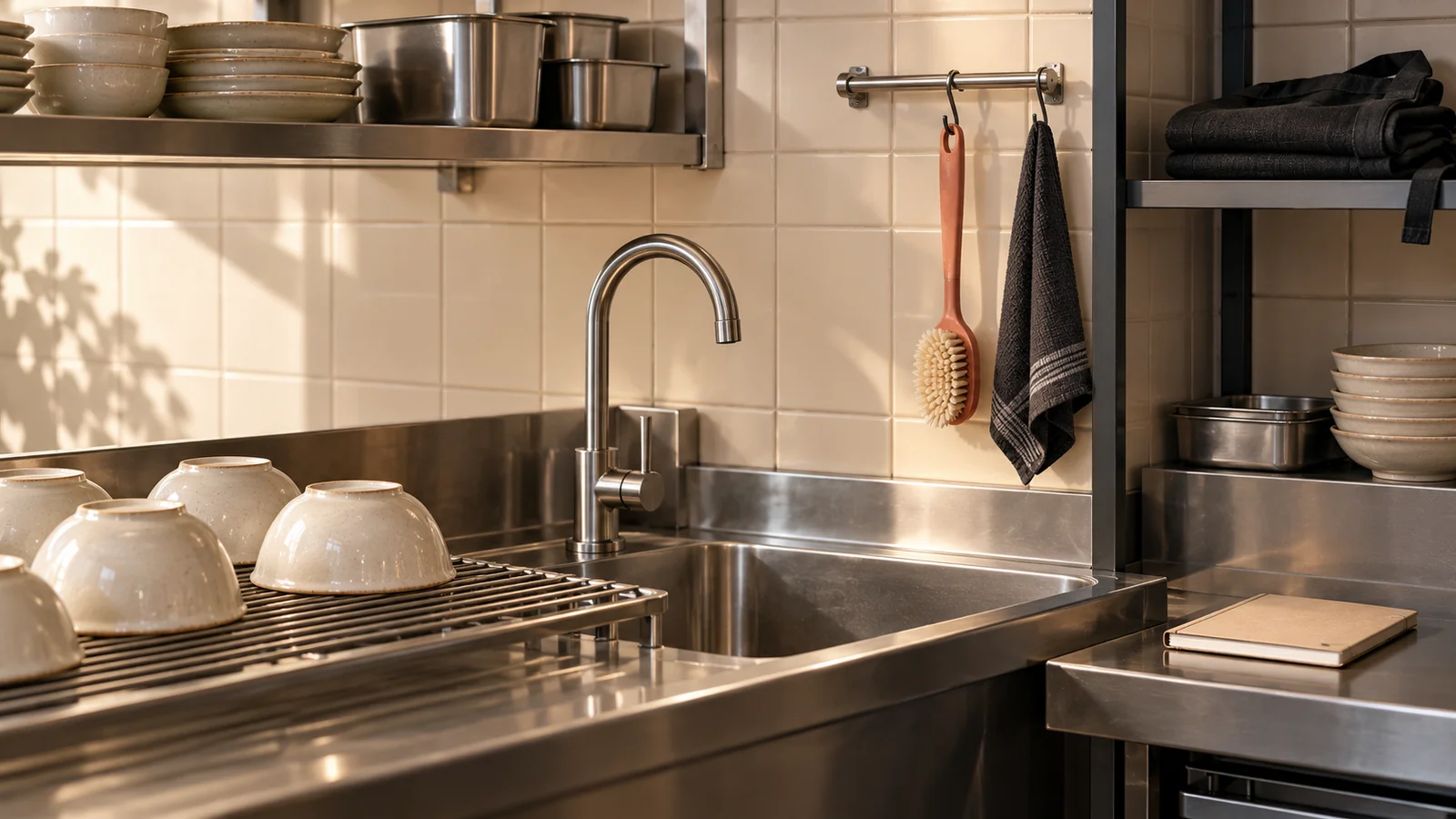
A useful kitchen cleaning plan links every surface to a responsible person, an approved work instruction and a decision on when it can return to use. Turn the room inventory into task cards and completed work into records that can be checked.
Scope: Restaurants and cafés in Türkiye. The daily, weekly and monthly arrangement below is an operating example to adapt, not a single statutory frequency for all restaurants. It is not a site-specific risk assessment or a professionally validated cleaning procedure.
Cleaning and disinfection are different tasks
Cleaning removes soil and food residues; disinfection aims to reduce microorganisms. Applying disinfectant to a dirty surface does not replace cleaning. Select the method for the actual surface and task. FAO/WHO Codex CXC 1-1969, section 11.1.
Türkiye’s Food Hygiene Regulation, article 14, requires effective cleaning of food-contact equipment, disinfection where necessary, and a frequency sufficient to prevent contamination. It does not assign the same timetable to every surface. Ministry regulation as originally published, hosted by FAOLEX. The following schedule is an operational proposal.
Use the same fields on every task card
Planning matrix: area/equipment and surface material → owner and deputy → procedure/version → frequency and event triggers → exact chemical name, authorized label and safety data sheet version → label dilution, application conditions and contact time → rinsing requirement and water conditions → monitoring/acceptance criteria → verifier/method → work and deviation record.
Do not leave the chemical field as “suitable product”. Before releasing a card, check the actual product’s intended food-contact use, compatibility with metals, plastics and seals, and the equipment maker’s safe dismantling and power-isolation instructions. Follow the authorized label and safety information for dilution, contact and rinsing; there is no universal mixture or number of minutes. Never mix products. Resolve unclear or conflicting instructions with the supplier and competent supervisor before starting.
Example daily, weekly and monthly task matrix
Each row below includes the common chemical/contact/rinsing fields above. A competent assessment must set frequencies using workload, food, surface and verification results. Spills and contamination require action without waiting for the calendar.
- Daily and at relevant task changes — prep counters, boards and removable food-contact parts. Owner: station worker; deputy named on the rota. Protect/remove food, dismantle safely, remove debris, clean appropriately and disinfect if required. Follow label contact/rinsing conditions; dry/store without recontamination. Monitor visible residues and process parameters. Verification: chef reviews the card and practice, with suitable tests at risk-selected points. Record equipment ID, times, parameters, results and release.
- Daily closing and as needed — floors, drain surrounds, waste bins and cleaning tools. Owner: cleaning worker; check: closing supervisor. Use tools separated from food-contact work and avoid splashing; clean and store the tools too. Chemical/contact/rinsing conditions: separate surface card. Monitor deposits and splashes. Verification: closing walk-through and record review. Record area, completion, defect and recheck.
- Example weekly deep clean — refrigerator shelves, door seals and accessible areas under equipment. Owner: store/station supervisor with a deputy. Protect food storage conditions while emptying, obtain safe access and clean to manufacturer instructions using the product’s contact/rinsing conditions. Monitor soil, damage and reassembly. Verification: chef’s spot check and comparison with earlier deviations. Record part, work, repair request and approval. Do not leave visible dirt until the weekly slot.
- Example monthly programme review — extraction hood/filters, difficult-access areas and chemical store. Owner: manager, using a competent maintenance contractor where needed. Review buildup, access, labels, stock and instructions. Set actual cleaning/service intervals separately using manufacturer guidance, fire risk and site conditions. Chemical/contact/rinsing conditions belong on the relevant cleaning card. Verify reports, record trends and corrective-action closure; record plan changes, work orders and acceptance. A monthly review does not mean monthly hood cleaning is always sufficient.
Separate visual checks from verification
Looking for residues at task completion is routine monitoring. Verification additionally evaluates whether the programme is applied and achieves its intended result, through record review, observation and risk-appropriate surface tests. Appearance alone cannot demonstrate microbiological safety or absence of allergens. Agree sampling sites, methods, acceptance criteria and intervals with a competent food specialist; arbitrary test results are not a release rule. Codex, section 11.1.3.
After allergen-containing production, do not rely on disinfection alone: plan removal of allergen residues and appropriate allergen verification where needed. Include seals and joints. A general hygiene indicator is not allergen-specific evidence; do not promise “allergen-free”. Codex, sections 11.1.3 and 13.2.7.
Chemical storage and shift sign-off
Do not store cleaning/disinfection chemicals in food-handling areas. See the Ministry publication, general requirements and Regulation, article 10(10). Suggested practice: use designated secure storage, retain readable original labels and never decant into food/drink containers. Any working container needs clear identification according to product and safety instructions; remove unidentified bottles from use.
Name a closing supervisor and deputy each shift. The worker signs completed work; the supervisor checks omissions, contact/rinsing records and equipment release. On failure, hold equipment from use, refer potentially affected food for a responsible assessment, repeat the prescribed process and document the recheck. Never backfill an empty form the next day.
Record matrix: date/site/shift → card/version → equipment → operator → product/label reference and measured parameters → start/end/contact time → rinse completed or omitted with basis → visual check → verification method/result → deviation, affected food and correction → recheck → closing supervisor/time. See preparing for a restaurant inspection for file organisation.
Dates and source limits
Displayed publication: 16 October 2026, 09:00 UTC. Actual source check: 28 October 2026. The Ministry publication, the original Regulation on FAOLEX and FAO/WHO’s 2023 Codex edition incorporating 2022 revisions were opened and checked. Older catering-guide links were inaccessible and were not treated as verified evidence. This is not verification of every amendment in current consolidated law. Confirm site-specific legal scope with the authority and the technical plan with a competent food specialist. No site-specific expert review was performed for this article.