Which documents should you check when choosing a supplier?
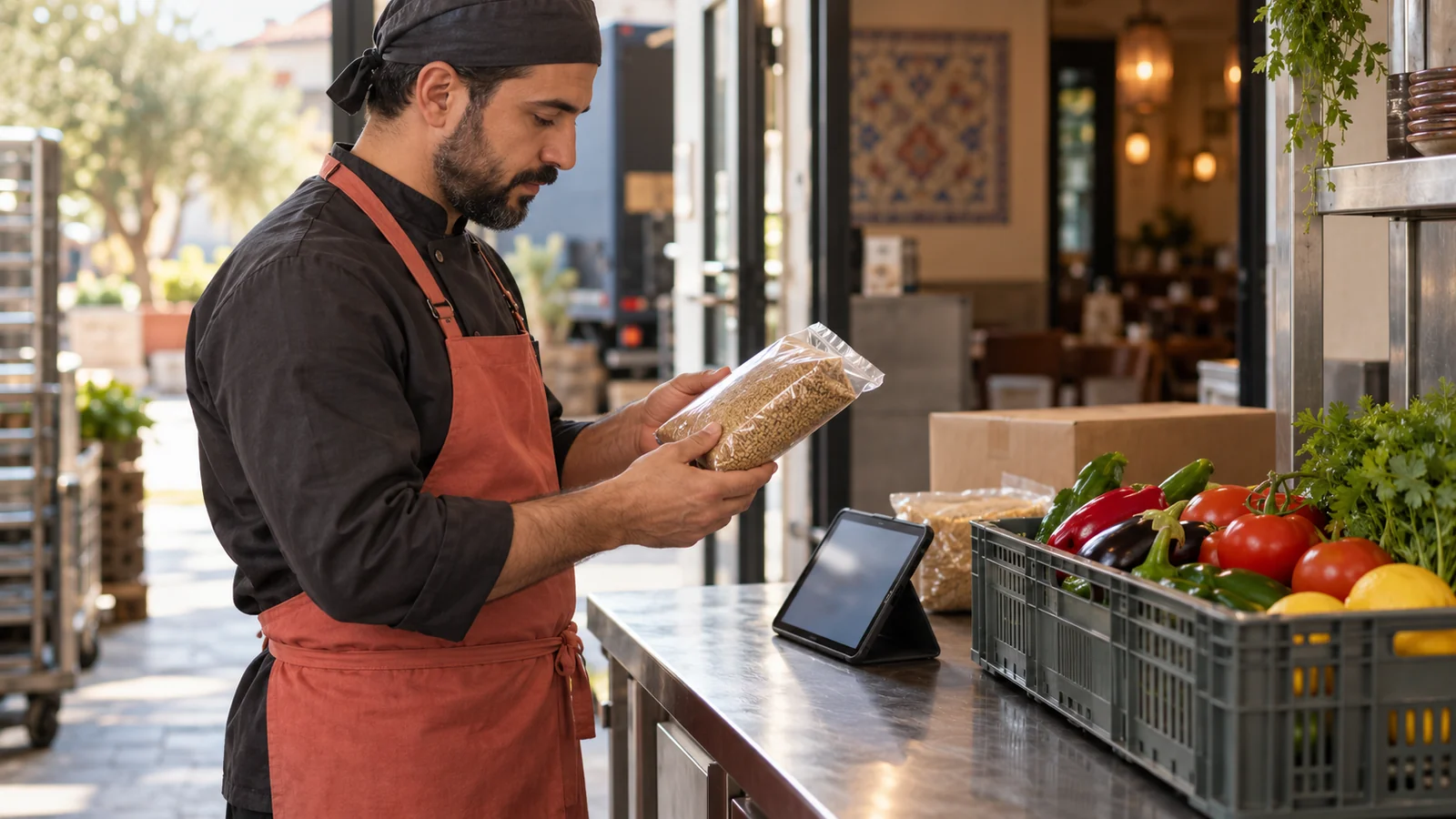
When choosing a restaurant supplier, first verify that the right establishment is registered or approved for the relevant activity. Then check the products you will buy, their batch traceability and delivery conditions. An ISO certificate, an invoice or an attractive price cannot replace these checks. Keep separate establishment, product and delivery records instead of requesting an identical document pack from every supplier.
Scope: Food procurement by restaurants and cafés in Türkiye. The form below is a purchasing-management recommendation; not every line is a mandatory document for every business. Detailed import, organic-product and specialist product rules are outside this article. Sources checked: 29 October 2026.
1. Match the business identity to the actual supply chain
Record the legal name on the quotation, contract and invoice alongside production, storage and dispatch addresses. Request tax details and an authorised contact to verify the commercial relationship. These do not constitute food-safety approval. If buying through an intermediary, identify the manufacturer and dispatch depot separately. Do not use a head-office document as evidence for a facility at another address.
2. Distinguish registration from approval
Registration and approval depend on the activity; do not demand both from every supplier. Match the product and activity against the Ministry’s scope list. Ministry of Agriculture and Forestry registration/approval guide.
Record the document number, legal name, facility address, activity covered, verification date and reviewer. Use the current official enquiry service; ask the provincial/district directorate if the result is unclear. A photocopy alone is insufficient. Resolve discrepancies in name, address or scope through explanation and official verification before adding the product to the approved purchasing list. See also our document and certificate guide.
3. Connect the product file to delivery records
Define the exact product, ingredients, allergens, packaging, storage conditions and minimum remaining shelf life at receipt in the specification. Restaurants must provide allergen information. Ministry allergen guidance. Obtain written ingredient and allergen information and require advance notification of changes in the contract. Recheck kitchen and menu records when the brand or formulation changes.
Traceability means being able to follow a product through the supply chain and is a legal obligation. Law No. 5996, Article 24. In practice, link invoice/delivery-note references to the product, quantity, batch/lot, date and receiving employee. This is a recommended record structure, not a universal requirement to put every field on one document. Select a delivery and test whether you can actually find the stock entry for its batch.
4. Request evidence appropriate to the product
- Chilled or frozen goods: Agree product-specific transport conditions, measurement methods and acceptance/rejection limits with the food-safety lead. Assess shipment temperature evidence together with observations at receipt; do not apply one temperature limit to all products.
- Test report: Request one when required by the risk assessment, product rules or contract. Match product/batch, sampling date, test parameters and laboratory scope. A result for one sample does not guarantee all subsequent deliveries.
- Special claims or imported products: Verify applicable evidence under the competent authority’s current product-specific rules. Organic claims, import documents and health certificates do not apply identically to every food. Complete the assessment before passing the claim on to customers.
5. Interpret voluntary certification correctly
ISO 22000 certification is voluntary. ISO’s explanation of certification. If supplied, verify its number, issuer, current validity, facility address and activity scope with the certification body. Do not treat it as a batch conformity report.
HACCP means hazard analysis and critical control points. The obligation to operate a HACCP-based system outside primary production is distinct from third-party certification. Law No. 5996, Article 29. Neither “no certificate means nothing can be done” nor “a certificate removes the need to check” is a sound conclusion.
6. Compare the file with the first delivery
The receiving employee should record the ordered product and quantity, packaging integrity, date/batch information, vehicle cleanliness and necessary temperature checks. Do not release nonconforming food for use: segregate it, notify the responsible person and document rejection/return decisions. Never taste a suspect product to assess safety. Compromising safety is not a waste-reduction method. See the cold-chain guide.
A supplier assessment form to copy
- Identity: Company / facility / product group / contact / reviewer / date.
- Evidence: Registration-approval scope / product-allergen file / traceability test / delivery conditions / applicable specialist document.
- Each line: Document or record reference / verification method / compliant, missing or not applicable / reason / owner / completion date.
- Decision: Approve, grant time-limited conditional approval only for noncritical gaps, or reject. Unresolved operating authority or food safety pauses procurement; a lower price cannot offset it.
- Follow-up: First-delivery result / nonconformity and closure evidence / next review date / person responsible for change notification.
After passing the safety and compliance threshold, compare price, on-time delivery, minimum order, return terms and alternative supply capacity. Use the same unit, net quantity, tax and transport basis. This article promises no industry savings rate or cost guarantee.
Recall and reassessment
Request emergency contacts and the supplier’s recall process. If safety is in doubt, isolate the relevant goods, locate batch movements and assess statutory notification/withdrawal steps with the responsible specialist. The operator retains responsibility for unsafe products. Law No. 5996, Article 22. Reopen the file when the address, ingredients, document status or dispatch arrangements change; do not wait for the next scheduled review.
Action today: Complete the form for your three most critical suppliers. Trace one real delivery to its batch and assign owners and deadlines to gaps. Go beyond collecting documents: establish that the documents, goods and delivery describe the same chain.