How can restaurants prevent cross-contamination?
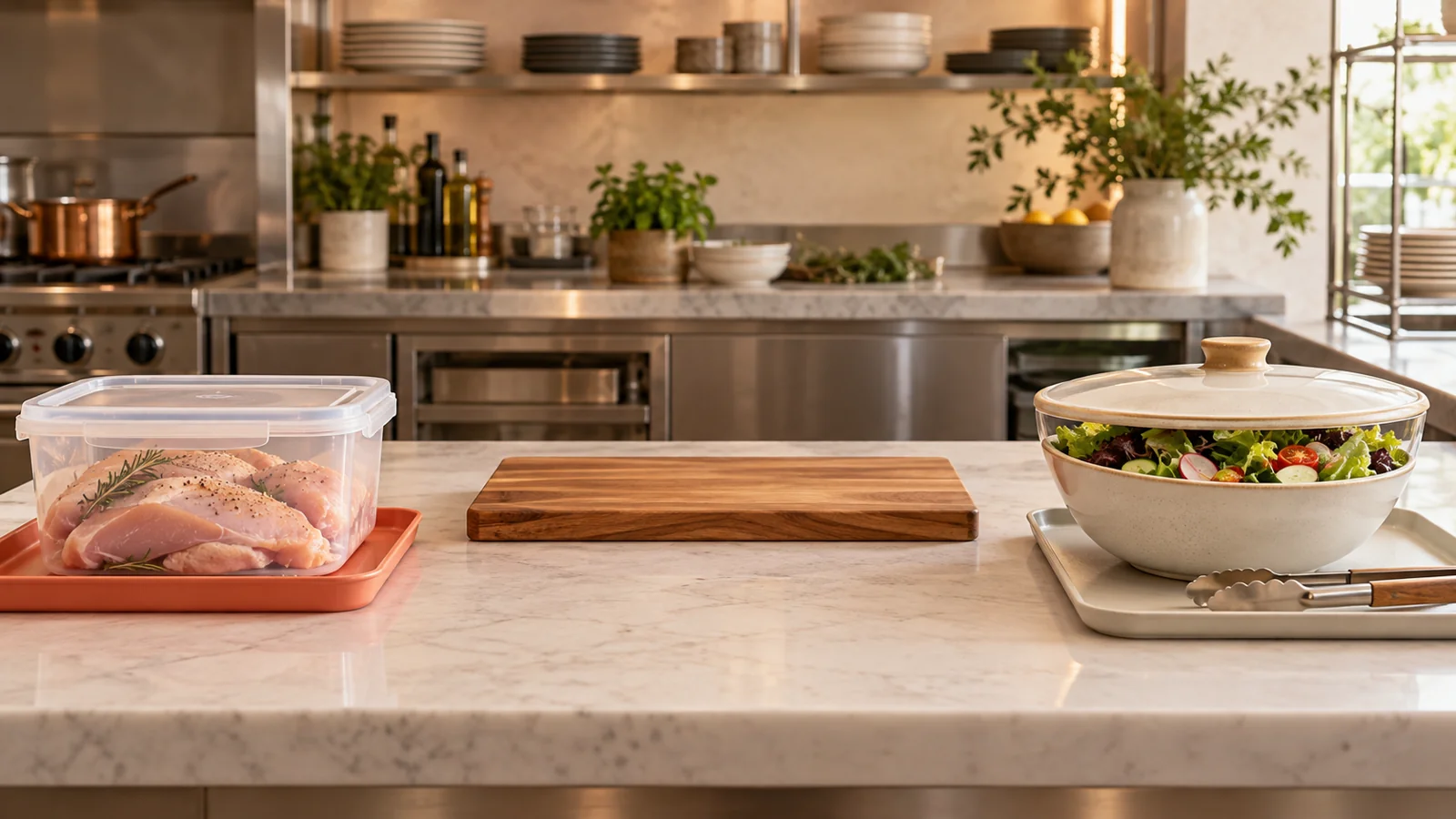
Prevent cross-contamination by separating the routes of raw and ready-to-eat food and defining what happens when people, equipment or surfaces cross that boundary. Coloured boards help identification; a misused or inadequately cleaned board is not safe simply because of its colour.
Scope: restaurants and cafés in Türkiye. The duties and records below are operational suggestions, not a verbatim legal requirement, a site-specific HACCP plan or a compliance guarantee.
Two hazards, two control questions
Biological cross-contamination transfers harmful microorganisms, for example from raw chicken to salad through hands, knives or juices. Allergen cross-contact unintentionally transfers an allergen from one food to another; it does not depend on microbial growth. Cooking is not an answer to every allergen risk and does not remove all allergens. Record intentional recipe ingredients separately from unintended contact.
WHO identifies separation of raw and cooked food as a core message. Codex treats microbiological contamination and allergen management in separate sections. WHO · FAO/WHO Codex 13.2.4 / 13.2.7
Receiving to service: duty → evidence → deviation
- Receiving — purchasing/store lead: Check packaging integrity, leaks, product identity and current supplier allergen information. Evidence: date, supplier, batch, acceptance decision and measurements where required by your criteria. Hold leaking goods or an unclear substitution away from use and escalate.
- Storage — storekeeper: Choose containers and positions that prevent raw juices reaching ready-to-eat food. Keep open allergenic ingredients identified, covered and arranged to prevent spills. Evidence: shelf/container inspection and corrections. Isolate affected food after a spill; moving the container alone does not close the incident.
- Preparation — station lead: Provide separate raw and ready-to-eat areas/equipment. If space must be shared, separate tasks in time and complete effective cleaning and necessary disinfection between them. Evidence: handover check, method and checker. Stop preparation when cleaning is incomplete and identify exposed food.
- Cooked food — cook: Never return cooked food to a raw-food plate or use raw-food tongs. Transfer it to clean containers in a protected holding area. Evidence: transfer observation and product-specific procedure measurements. Hold food after renewed contact; reheating is not an automatic rescue.
- Service — service lead: Keep clean utensils with their intended dish; check shared sauce spoons, garnish containers and returned plates. Confirm allergen requests with the kitchen and match the plate to the guest. Evidence: order communication and handover check. Stop delivery if information or plates are mixed up; do not guess.
Walk this route during busy service. Türkiye’s Ministry specifically advises against consuming uncooked foods such as bread and salad that have contacted raw chicken. Türkiye: Ministry of Agriculture and Forestry
Hands, cloths and small equipment
Make handwashing with soap and water part of the change from raw to ready-to-eat work. Gloves do not replace handwashing; change them appropriately between tasks. Fridge handles, phones, taps, probes and aprons can also transfer contamination. Do not circulate a cleaning cloth between stations. Explain your colour code to staff rather than assuming a universal scheme.
Cleaning removes residues; disinfection has a different purpose
Cleaning targets food residues and dirt, including allergenic residues. Disinfection targets microorganisms and cannot replace allergen removal. Visibly clean does not prove the absence of allergens. Specify a written method suitable for the food, surface and equipment; follow the manufacturer’s application, contact and rinsing instructions. This guide gives no universal chemical mixture or dose. FAO/WHO Codex 11
Assess the method with a competent food specialist and choose suitable allergen/protein or microbiological checks where risk requires them. A surface test does not guarantee that an entire meal is allergen-free. Evaluate shared fryer oil, grills, blenders and serving tools against actual controls rather than appearance before accepting a request.
Manage the affected food as well as the surface
Stop the task → isolate affected food/batches from service → inform the responsible person → decide disposition using competent assessment and your written procedure → clean and, where necessary, disinfect → verify before restarting. If food reached service, activate the site’s incident, withdrawal and authority-notification procedures. This article does not decide incident-specific legal or medical questions.
Suggested record: date/time, station, product/batch, transfer route, observer, stop/hold action, food decision and basis, cleaning check, cause, correction owner and closure approval. Repeated errors may require changes to layout, capacity or work sequence rather than another reminder.
Continue with the related guides
Dates and source limits: Displayed publication: 14 October 2026, 09:00 UTC. Actual source check: 28 October 2026; the check is not backdated. The WHO page, Ministry statement dated 17 July 2026 and sections 11 and 13 of the 2023 FAO/WHO Codex publication incorporating the 2022 revisions were opened and checked. Older CXC 80-2020 links did not return a readable document, so no verified rulings are attributed to them. Confirm current local obligations with the competent authority and technical controls and product-specific times/temperatures with a qualified specialist. No site-specific expert review was performed for this article.